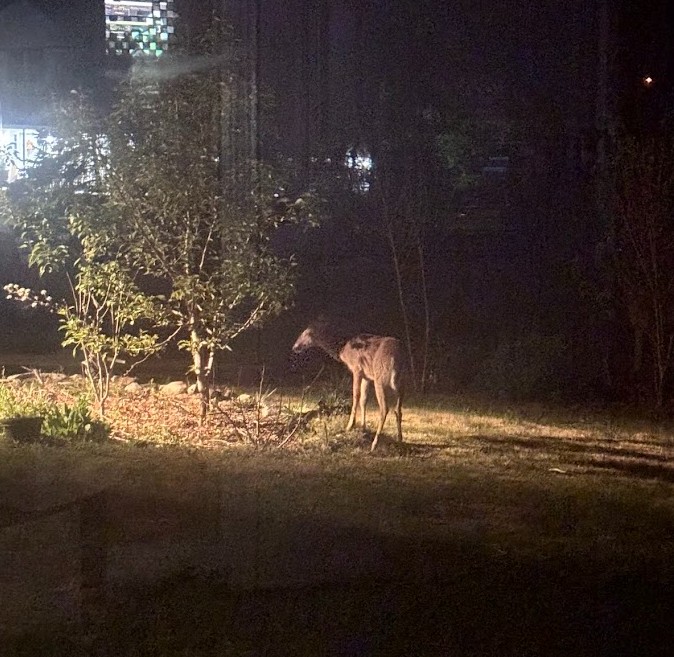
Last night at 3am my son noticed the driveway motion light flick on out his bedroom window. No, it didn’t wake him up – my gaming vampire is running on the fumes of youth most of the time instead of sleep as he bombards assailants and conquers adversaries every night with allies and close friends from across the globe.
Upon inspection, it turns out that we had a visitor to the food forest.
They found me. I don’t know how, but they found me.
Well, that’s not true. I basically plant a buffet. Might as well have a flashing neon sign above the cherry tree… Eat Here – Open 24 Hours!
I have been noticing evidence of browse on the red leafed sand cherry and the Asian pear tree. I’m surprised there hasn’t been more damage, honestly. Well, yet, anyway.
I do think it’s interesting that a mixed polyculture seems to have a better chance to avoid complete destruction because there will be things that are a tasty choice and things they don’t prefer to eat.
I hope they leave some for us.
Helping to start a perennial tea garden
My delightful friend Vicki Weiss, innkeeper of the Mathis House, a Victorian bed and breakfast in Toms River, NJ, expressed in a recent video that she wanted to start a tea garden. Vicki hosts tea parties at Mathis House and is a great lover of tea herself. Though an inexperienced gardener, she planned to start her tea from seed this season. Since many of the plants throughout my yard can be used to make tea, I brought some young starter plants for her to enjoy and dropped them off yesterday before heading to another event.
The plants I shared are fennel, purple cone flower (echinacea), anise hyssop, mountain mint, lemon balm, and cat mint. All easy to grow and should return year after year.
I’ll bring her another round later in the season and share passion flower, hibiscus, red raspberry, oregano, uva ursi, and thyme.
What are your favorite tea plants to grow? What are the benefits of those plants?